
Brett and I made our first trip to Boston in October of 2019. We usually go out west to go hiking in the fall but this year Brett said he wanted to go to a city. New York was out because he grew up there until late high school and I traveled there for work for many years. I had also been to Chicago and we wanted to go somewhere different so we picked Boston. There’s so much history in this city and I don’t think we really appreciated it while we were there. We were busy eating and sightseeing.

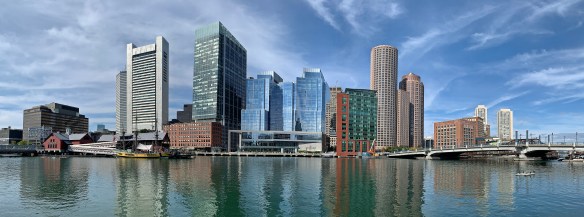
We stayed near the harbor (our hotel was the silver/blue one in the middle). We had the Boston Tea Party Museum out our back door (in the water on the left).


What we celebrate today really started here. Demonstrators boarded the tea ship at night and threw the tea overboard to protest the Tea Act of 1773. This protest accelerated the American Revolution. From Wikipedia – The Tea Party was the culmination of a resistance movement throughout British America against the Tea Act, a tax passed by the British Parliament in 1773. Colonists objected to the Tea Act believing it violated their rights as Englishmen to “no taxation without representation“, that is, to be taxed only by their own elected representatives and not by a parliament in which they were not represented.
The statue is of Samuel Adams (who’s family owned a brewery). He was one of the Founding Fathers of the US and a signer of the Declaration of Independence.

A view of the city from the water.


We saw a lot of flags here.

Another statue of Samuel Adams. This one is in front of Faneuil Hall (which was getting a facelift when we were there). It opened in 1742 and was a meeting hall at the time with Adams giving speeches encouraging independence from Great Britain. It’s still open as a marketplace.

We spent an afternoon walking through Boston Common, the oldest city park in the US. It started out as a cow pasture and was used by the British as a military camp right before the Revolution.

Paul Revere started his midnight “one if by land, two if by sea” ride here. You can read about it here.

Another prominent figure in the Revolution was William Dawes Jr, who also made a ride to warn of approaching British soldiers. He is said to be buried here in the King’s Chapel Burying Ground.


Some of the headstones in the King’s Chapel Burying Ground, established in 1630. It is the oldest cemetery in the city.


By the end of the week we were tired of walking and took a bus tour around the city. It went by the Granary Burying Ground on the edge of Boston Common, established in 1660. Many Revolutionary War patriots are buried here including 3 signers of the Declaration of Independence. Samuel Adams (gravestone above. I took the picture while we were stuck in traffic.), John Hancock and Robert Treat Paine as well as Paul Revere. Ben Franklin’s (who also signed the Declaration) parents are buried here while he is buried in Philadelphia.

I took this as we were flying home. I’m sure the view was much different back in the late 1700’s.